844
click to vote
Dataset

Active contours, or snakes, are computer-generated curves that move within images to find object boundaries. Its 3D version is often known as deformable models or active surfaces ...
908
click to vote
Tutorial

Active contours, or snakes, are computer-generated curves that move within images to find object boundaries. Its 3D version is often known as deformable models or active surfaces ...
961
click to vote
Source Code
Active contours, or snakes, are computer-generated curves that move within images to find object boundaries. Its 3D version is often known as deformable models or active surfaces ...
369
click to vote
CVPR
1997
IEEE
14 years 4 months ago
1997
IEEE
Snakes, or active contours, are used extensively in computer
vision and image processing applications, particularly
to locate object boundaries. Problems associated with
initial...
398
click to vote
TIP
1998
14 years 4 months ago
1998

Snakes, or active contours, are used extensively in
computer vision and image processing applications, particularly
to locate object boundaries. Problems associated with initiali...
387
click to vote
TMI
2002
15 years 7 months ago
2002
Inflammatory disease is initiated by leukocytes (white blood cells) rolling along the inner surface lining of small blood vessels called postcapillary venules. Studying the number ...
325
click to vote
IJCNN
2006
IEEE
16 years 2 months ago
2006
IEEE

—This paper presents an Improved Snake Model (ISM) effective for performing fast image segmentation. The work takes advantage of two well-known snake models of Balloon [1] and GG...
410
click to vote
ICASSP
2007
IEEE
16 years 2 months ago
2007
IEEE
Segmentation and tracking methods have been widely explore. However, they are often computationally heavy or require constraining assumptions. We present in this paper a new syste...
311
click to vote
MICCAI
2007
Springer
16 years 9 months ago
2007
Springer
We present an approach to detect anatomical structures by configurations of interest points, from a single example image. The representation of the configuration is based on Markov...
432
click to vote
ICPR
2008
IEEE
16 years 9 months ago
2008
IEEE
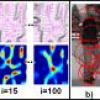
We propose a novel set of medial feature interest points based on gradient vector flow (GVF) fields [18]. We exploit the long ranging GVF fields for symmetry estimation by calcula...