Source Code
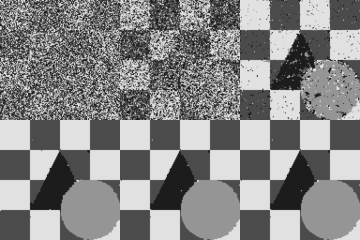
This is the sample implementation of a Markov random field based image segmentation algorithm described in the following papers:
1. Mark Berthod, Zoltan Kato, Shan Yu, and Josi...
Source Code
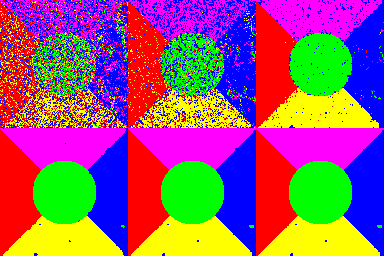
This is the sample implementation of a Markov random field based color image segmentation algorithm described in the following paper:
Zoltan Kato, Ting Chuen Pong, and John Chu...
CVPR
2010
IEEE
14 years 25 days ago
2010
IEEE
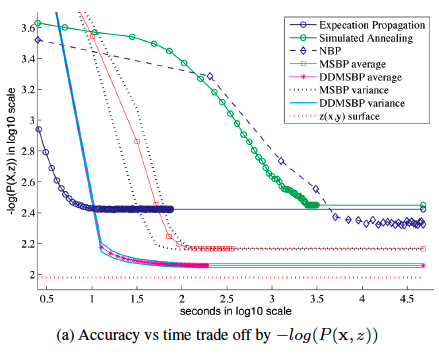
We introduce a novel data-driven mean-shift belief propagation
(DDMSBP) method for non-Gaussian MRFs, which
often arise in computer vision applications. With the aid
of scale sp...
ICCV
2009
IEEE
14 years 9 months ago
2009
IEEE

We present a novel multi-view stereo method designed
for image-based rendering that generates piecewise planar
depth maps from an unordered collection of photographs.
First a di...
ICCV
2009
IEEE
14 years 9 months ago
2009
IEEE
Partially occluded faces are common in many applications
of face recognition. While algorithms based on sparse
representation have demonstrated promising results, they
achieve t...
CVPR
2009
IEEE
14 years 11 months ago
2009
IEEE
In this paper, we introduce a higher-order MRF optimization
framework. On the one hand, it is very general;
we thus use it to derive a generic optimizer that can be applied
to a...
CVPR
2009
IEEE
14 years 11 months ago
2009
IEEE
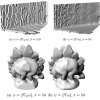
Convex and continuous energy formulations for low level
vision problems enable efficient search procedures for the
corresponding globally optimal solutions. In this work we
exte...
CVPR
2009
IEEE
14 years 11 months ago
2009
IEEE
Many computer vision problems can be formulated in
a Bayesian framework with Markov Random Field (MRF)
or Conditional Random Field (CRF) priors. Usually, the
model assumes that ...
CVPR
2009
IEEE
14 years 11 months ago
2009
IEEE
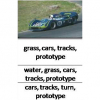
Much research effort on Automatic Image Annotation
(AIA) has been focused on Generative Model, due to its
well formed theory and competitive performance as compared
with many we...
CVPR
2009
IEEE
14 years 11 months ago
2009
IEEE
Markov random field (MRF, CRF) models are popular in
computer vision. However, in order to be computationally
tractable they are limited to incorporate only local interactions
a...