2490 search results - page 245 / 498 » A General Method for Feature Matching and Model Extraction |
169
click to vote
TNN
2011
14 years 11 months ago
2011

Domain adaptation solves a learning problem in a target domain by utilizing the training data in a different but related source domain. Intuitively, discovering a good feature rep...
119
click to vote
CGF
2008
15 years 4 months ago
2008
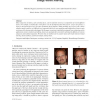
Many categories of objects, such as human faces, can be naturally viewed as a composition of several different layers. For example, a bearded face with glasses can be decomposed i...
155
click to vote
ROMAN
2007
IEEE
15 years 10 months ago
2007
IEEE
— For a robot to understand a scene, we have to infer and extract meaningful information from vision sensor data. Since scene understanding consists in recognizing several visual...
142
click to vote
CVPR
2001
IEEE
16 years 6 months ago
2001
IEEE
We present a component-based, trainable system for detecting frontal and near-frontal views of faces in still gray images. The system consists of a two-level hierarchy of Support ...
147
click to vote
ICRA
1999
IEEE
15 years 8 months ago
1999
IEEE
: This paper develops methodology and technique for pose tracking of an autonomous mobile robot (AMR) using a laser scanner. A low-complexity and accurate pose-tracking EKF-based a...