508 search results - page 59 / 102 » A graphical model for protein secondary structure prediction |
101
Voted
ICML
2007
IEEE
16 years 1 months ago
2007
IEEE

We propose a class of graphical models appropriate for structure prediction problems where the model structure is a function of the output structure. Incremental Sigmoid Belief Ne...
92
Voted
BMCBI
2010
15 years 21 days ago
2010

Background: Protein conformation and protein/protein interaction can be elucidated by solution-phase Hydrogen/ Deuterium exchange (sHDX) coupled to high-resolution mass analysis o...
115
Voted
BIBE
2004
IEEE
15 years 4 months ago
2004
IEEE
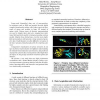
Large-scale biomedical data sets of macromolecular structures such as DNA and proteins describe highly complex biomolecular entities which often consist of thousands of atoms and ...
92
Voted
ISMB
2000
15 years 1 months ago
2000

Knowing the number of residue contacts in a protein is crucial for deriving constraints useful in modeling protein folding, protein structure, and/or scoring remote homology searc...
97
Voted
MCS
2010
Springer
15 years 5 months ago
2010
Springer

Abstract. The computational genome-wide annotation of gene functions requires the prediction of hierarchically structured functional classes and can be formalized as a multiclass, ...