586 search results - page 54 / 118 » Comparing Three Computational Models of Affect |
180
click to vote
ENVSOFT
2008
15 years 6 months ago
2008
In this paper two areas of soft computing (fuzzy modeling and artificial neural networks) are discussed. Based on the fundamental mathematical similarity of fuzzy technique and ra...
154
click to vote
TOG
2008
15 years 6 months ago
2008
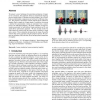
We present a novel technique for generating animation of laughter for a character. Our approach utilizes an anatomically inspired, physics-based model of a human torso that includ...
167
click to vote
CVPR
2007
IEEE
16 years 8 months ago
2007
IEEE

The active appearance model (AAM) is a powerful method for modeling deformable visual objects. One of the major drawbacks of the AAM is that it requires a training set of pseudo-d...
162
click to vote
ICALT
2007
IEEE
16 years 17 days ago
2007
IEEE
Deficiencies in the ability to map letters to sounds are currently considered to be the most likely early signs of dyslexia [4]. This has motivated the use of Literate, a compute...
186
click to vote
ADHOCNOW
2003
Springer
15 years 11 months ago
2003
Springer
This paper models an ad-hoc network as a continuum of nodes, ignoring edge effects, to find how the traffic scales with N, the number of nodes. We obtain expressions for the traffi...