303 search results - page 30 / 61 » Facial Expression Space Learning |
154
click to vote
NIPS
2008
15 years 5 months ago
2008

Existing approaches to nonrigid structure from motion assume that the instantaneous 3D shape of a deforming object is a linear combination of basis shapes, which have to be estima...
164
click to vote
FGR
2011
IEEE
14 years 7 months ago
2011
IEEE
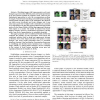
— Matching images with large geometric and iconic changes (e.g. faces under different poses and facial expressions) is an open research problem in computer vision. There are two ...
157
click to vote
CVPR
2004
IEEE
16 years 5 months ago
2004
IEEE

In this paper, we consider the problem of super-resolving a human face video by a very high (?16) zoom factor. Inspired by recent literature on hallucination and examplebased lear...
159
click to vote
MVA
2000
15 years 5 months ago
2000
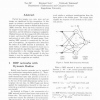
work, applies a nonlinear transformation from the input space to the hidden space. The output layer Partial face images, e.g.1 eyes, nose, and ear supplies the response of the netw...
136
click to vote
IEEEMM
2007
15 years 3 months ago
2007
— Microarray technology offers a high throughput means to study expression networks and gene regulatory networks in cells. The intrinsic nature of high dimensionality and small s...