191 search results - page 25 / 39 » Fast motion estimation and motion segmentation using multi-s... |
145
click to vote
ICIP
2007
IEEE
16 years 6 months ago
2007
IEEE
In this work, we solve the pose estimation problem for robot motion by placing multiple cameras on the robot. In particular, we use four cameras arranged as two back-to-back stere...
149
click to vote
CVPR
2005
IEEE
16 years 7 months ago
2005
IEEE
We introduce a behavior-based similarity measure which tells us whether two different space-time intensity patterns of two different video segments could have resulted from a simi...
160
click to vote
ICASSP
2009
IEEE
15 years 12 months ago
2009
IEEE
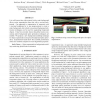
It is well known that video material with a static background allows easier segmentation than that with a moving background. One approach to segmentation of sequences with a movin...
160
click to vote
WACV
2008
IEEE
15 years 11 months ago
2008
IEEE

In this paper, we tackle robust human pose recognition using unlabelled markers obtained from an optical marker-based motion capture system. A coarse-to-fine fast pose matching al...
139
click to vote
ICRA
2006
IEEE
15 years 11 months ago
2006
IEEE

— A robot exploring an environment can estimate its own motion and the relative positions of features in the environment. Simultaneous Localization and Mapping (SLAM) algorithms ...