14347 search results - page 2486 / 2870 » Interactive Granular Computing |
163
click to vote
VISUALIZATION
2005
IEEE
15 years 10 months ago
2005
IEEE
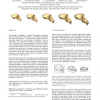
We introduce a technique to visualize the gradual evolutionary change of the shapes of living things as a morph between known three-dimensional shapes. Given geometric computer mo...
162
Voted
SMA
2005
ACM
15 years 10 months ago
2005
ACM

In contrast to machined mechanical parts, the 3D shapes encountered in biomedical or styling applications contain many tubular parts, protrusions, engravings, embossings, folds, a...
153
Voted
ICMI
2004
Springer
15 years 10 months ago
2004
Springer
Perhaps the most fundamental application of affective computing would be Human-Computer Interaction (HCI) in which the computer is able to detect and track the user’s affective ...
133
Voted
ICCSA
2003
Springer
15 years 9 months ago
2003
Springer
Abstract. This paper describes how function-based shape modeling can be expanded to web visualization, as well as how web-based visualization can be greatly improved by using the f...
127
click to vote
ICS
2001
Tsinghua U.
15 years 9 months ago
2001
Tsinghua U.
We describe the Slice Processor micro-architecture that implements a generalized operation-based prefetching mechanism. Operation-based prefetchers predict the series of operation...