720 search results - page 119 / 144 » Mobile robot navigation using sensor fusion |
132
Voted
ICRA
2009
IEEE
15 years 11 months ago
2009
IEEE
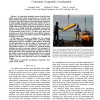
— In cooperative navigation, teams of mobile robots obtain range and/or angle measurements to each other and dead-reckoning information to help each other navigate more accuratel...
144
click to vote
ICRA
2005
IEEE
15 years 10 months ago
2005
IEEE

Abstract— Mobile robots can be easily equipped with numerous sensors which can aid in the tasks of localization and ego-motion estimation. Two such examples are Inertial Measurem...
142
click to vote
HRI
2006
ACM
15 years 11 months ago
2006
ACM
Autonomous robots use sensors to perceive and track objects in the world. Tracking algorithms use object motion models to estimate the position of a moving object. Tracking effic...
150
click to vote
ICRA
1998
IEEE
15 years 9 months ago
1998
IEEE
1 sensors is to construct a structural description from sensor data and to match this description to a previously acquired model [Crowley 85]. An alternative is to project individu...
139
click to vote
TFS
2008
15 years 5 months ago
2008
Abstract--Flocking algorithms essentially consist of three components: alignment, cohesion, and separation. To track a desired trajectory, the flock center should move along the de...