901 search results - page 45 / 181 » On 3D Topological Relationships |
123
click to vote
ICCV
2005
IEEE
16 years 3 months ago
2005
IEEE

For a large object, scanning from the air is one of the most efficient methods of obtaining 3D data. But in the case of large cultural heritage objects, there are some difficultie...
107
click to vote
IPMI
2001
Springer
16 years 2 months ago
2001
Springer
Skeleton is a frequently applied shape feature to represent the general form of an object. Thinning is an iterative object reduction technique for producing a reasonable approximat...
127
click to vote
BMCBI
2005
15 years 1 months ago
2005
Background: The identification of local similarities between two protein structures can provide clues of a common function. Many different methods exist for searching for similar ...
145
click to vote
BMCBI
2008
15 years 2 months ago
2008
Background: Recent approaches for predicting the three-dimensional (3D) structure of proteins such as de novo or fold recognition methods mostly rely on simplified energy potentia...
103
click to vote
IJMMS
2011
14 years 9 months ago
2011
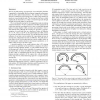
The law of path steering, as proposed by Accot and Zhai, describes a quantitative relationship between human temporal performance and the path’s spatial characteristics. The ste...