1992 search results - page 38 / 399 » On the (limited) power of non-equivocation |
IJCAI
2003
15 years 3 months ago
2003

Efficient implementations of DPLL with the addition of clause learning are the fastest complete satisfiability solvers and can handle many significant real-world problems, such as...
101
click to vote
BIRTHDAY
2010
Springer
15 years 2 months ago
2010
Springer
Abstract. We investigate the power of play-out, the execution mechanism associated with scenario-based programming, which was defined as the operational semantics of live sequence ...
128
click to vote
TWC
2008
15 years 1 months ago
2008
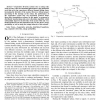
Cooperative diversity systems rely on using relay nodes to relay copies of transmitted information to the destination such that each copy experiences different channel fading, henc...
MOC
1998
15 years 1 months ago
1998
This paper reports on new results for the equation m i=1 ak i = n j=1 bk j , i.e., equal sums of like powers. Since the 1967 Lander, Parkin and Selfridge survey paper [4], few othe...
119
click to vote
ICCAD
2001
IEEE
15 years 10 months ago
2001
IEEE
The use of nanometer technologies is making it increasingly important to consider transient characteristics of a circuit’s power dissipation (e.g., peak power, and power gradien...