1153 search results - page 117 / 231 » Reversing graph transformations |
135
Voted
DGCI
2008
Springer
15 years 5 months ago
2008
Springer
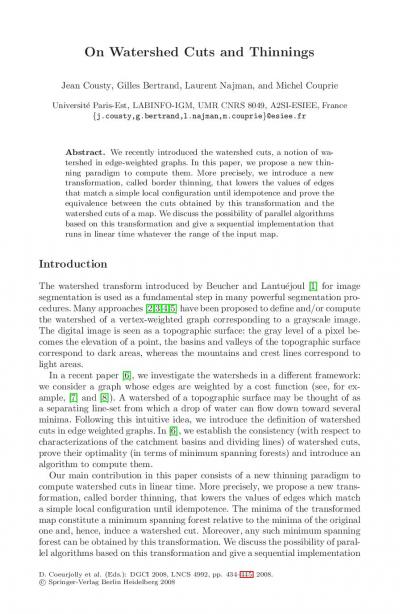
Abstract. We recently introduced the watershed cuts, a notion of watershed in edge-weighted graphs. In this paper, we propose a new thinning paradigm to compute them. More precisel...
116
Voted
DCC
2008
IEEE
16 years 3 months ago
2008
IEEE

The name `graph state' is used to describe a certain class of pure quantum state which models a physical structure on which one can perform measurement-based quantum computin...
116
Voted
MFCS
2007
Springer
15 years 9 months ago
2007
Springer
Suppose we are given a graph G together with two proper vertex k-colourings of G, α and β. How easily can we decide whether it is possible to transform α into β by recolouring...
142
Voted
KDD
2009
ACM
16 years 4 months ago
2009
ACM
Our dynamic graph-based relational mining approach has been developed to learn structural patterns in biological networks as they change over time. The analysis of dynamic network...
126
Voted
ATAL
2005
Springer
15 years 9 months ago
2005
Springer
2. THE MASM ALGORITHM An input to the MASM algorithm is a time-annotated multi-agent action sequence. The action sequence is then transformed into an action graph. An action graph ...