4196 search results - page 88 / 840 » Unsupervised Learning of Relations |
158
click to vote
TIP
2002
15 years 2 months ago
2002
An unsupervised classification algorithm is derived by modeling observed data as a mixture of several mutually exclusive classes that are each described by linear combinations of i...
110
click to vote
IJCAI
2007
15 years 4 months ago
2007
In recent years, there has been a growing interest in using rich representations such as relational languages for reinforcement learning. However, while expressive languages have ...
ACL
2006
15 years 4 months ago
2006
We propose an unsupervised segmentation method based on an assumption about language data: that the increasing point of entropy of successive characters is the location of a word ...
142
click to vote
NAACL
2010
15 years 1 months ago
2010
We propose the first unsupervised approach to the problem of modeling dialogue acts in an open domain. Trained on a corpus of noisy Twitter conversations, our method discovers dia...
135
click to vote
CVPR
2006
IEEE
16 years 5 months ago
2006
IEEE
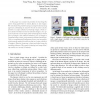
In this paper we consider the problem of describing the action being performed by human figures in still images. We will attack this problem using an unsupervised learning approac...