6740 search results - page 405 / 1348 » Using Classification as a Programming Language |
145
click to vote
POPL
2012
ACM
13 years 11 months ago
2012
ACM
We present an analysis which takes as its input a sequential program, augmented with annotations indicating potential parallelization opportunities, and a sequential proof, writte...
141
Voted
HIPEAC
2007
Springer
15 years 7 months ago
2007
Springer

Fine-grained program power behavior is useful in both evaluating power optimizations and observing power optimization opportunities. Detailed power simulation is time consuming and...
122
Voted
OZCHI
2009
ACM
15 years 10 months ago
2009
ACM
Millions of people in Canada have impairments that result in a loss of function and directly affect their ability to carry out activities of daily living. Many individuals with di...
118
Voted
ECOOPW
1999
Springer
15 years 8 months ago
1999
Springer
Moore’s Law is pushing us inevitably towards a world of pervasive, wireless, spontaneously networked computing devices. Whatever these devices do, they will have to talk to and n...
141
Voted
ICIP
2009
IEEE
16 years 4 months ago
2009
IEEE
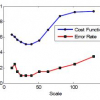
Scale-space representation of an image is a significant way to generate features for classification. However, for a specific classification task, the entire scale-space may not be...