1569 search results - page 287 / 314 » Using Organic Computing to Control Bunching Effects |
132
click to vote
MMAS
2010
Springer
14 years 11 months ago
2010
Springer
Based on the thermodynamic concept of a reservoir, we investigate a computational model for interaction with unresolved degrees of freedom (a thermal bath). We assume that a finite...
113
click to vote
CHI
2010
ACM
15 years 12 months ago
2010
ACM
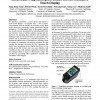
We introduce LensMouse, a novel device that embeds a touch-screen display – or tangible ‘lens’ – onto a mouse. Users interact with the display of the mouse using direct to...
151
click to vote
ATAL
2007
Springer
15 years 11 months ago
2007
Springer

Determining the provenance of data, i.e. the process that led to that data, is vital in many disciplines. For example, in science, the process that produced a given result must be...
143
click to vote
SIGGRAPH
1995
ACM
15 years 8 months ago
1995
ACM
Physically-based modeling has been used in the past to support a variety of interactive modeling tasks including free-form surface design, mechanism design, constrained drawing, a...
181
click to vote
VLSID
2007
IEEE
16 years 5 months ago
2007
IEEE
In the past, Field Programmable Gate Array (FPGA) circuits only contained a limited amount of logic and operated at a low frequency. Few applications running on FPGAs consumed exc...