150
click to vote
MM
2015
ACM
10 years 2 months ago
2015
ACM
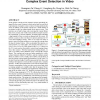
Event-specific concepts are the semantic concepts specifically designed for the events of interest, which can be used as a mid-level representation of complex events in videos. ...
125
click to vote
MM
2015
ACM
10 years 2 months ago
2015
ACM
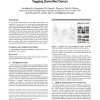
EventNet is the largest video event ontology existent today, consisting of 500 events and 4, 490 event-specific concepts systematically discovered from the crowdsource forum like...
141
click to vote
MM
2015
ACM
10 years 2 months ago
2015
ACM
HuEvent’15 is a continuation of previous year’s successful workshop on events in multimedia. It focuses on the humancentered aspects of understanding events from multimedia co...
134
click to vote
MM
2015
ACM
10 years 2 months ago
2015
ACM

There is an increasing interest in using hash codes for efficient multimedia retrieval and data storage. The hash functions are learned in such a way that the hash codes can pres...
139
click to vote
MM
2015
ACM
10 years 2 months ago
2015
ACM
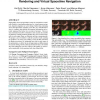
High-quality stereo and optical flow maps are essential for a multitude of tasks in visual media production, e.g. virtual camera navigation, disparity adaptation or scene editing...
137
click to vote
MM
2015
ACM
10 years 2 months ago
2015
ACM
We live in a data abundance era. Availability of large volume of diverse multimedia data streams (ranging from video, to tweets, to activity, and to PM2.5) can now be used to solv...
127
click to vote
MM
2015
ACM
10 years 2 months ago
2015
ACM
We address the problem of fine-grained action localization from temporally untrimmed web videos. We assume that only weak video-level annotations are available for training. The ...
141
click to vote
MM
2015
ACM
10 years 2 months ago
2015
ACM
Establishing common ground is one of the key problems for any form of communication. The problem is particularly pronounced in remote meetings, in which participants can easily lo...
137
click to vote
MM
2015
ACM
10 years 2 months ago
2015
ACM
In this paper a discriminant analysis (DA) technique called accelerated generalised subclass discriminant analysis (AGSDA) and its GPU implementation are presented. This method id...
136
click to vote
MM
2015
ACM
10 years 2 months ago
2015
ACM
We explore what names people use to describe visual concepts and why these names are chosen. Choosing object names has been a topic of interest in cognitive psychology, but a syst...