274
click to vote
CVPR
2012
IEEE
13 years 9 months ago
2012
IEEE
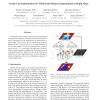
We present a generic framework for object segmentation using depth maps based on Random Forest and Graph-cuts theory, and apply it to the segmentation of human limbs in depth maps...
247
click to vote
CVPR
2012
IEEE
13 years 9 months ago
2012
IEEE

This paper presents a novel method for estimating the geospatial trajectory of a moving camera with unknown intrinsic parameters, in a city-scale urban environment. The proposed m...
251
click to vote
CVPR
2012
IEEE
13 years 9 months ago
2012
IEEE
Trajectory basis Non-Rigid Structure From Motion (NRSFM) currently faces two problems: the limit of reconstructability and the need to tune the basis size for different sequences....
236
click to vote
CVPR
2012
IEEE
13 years 9 months ago
2012
IEEE

A novel method is proposed for matching articulated objects in cluttered videos. The method needs only a single exemplar image of the target object. Instead of using a small set o...
225
click to vote
CVPR
2012
IEEE
13 years 9 months ago
2012
IEEE
We present a photometric stereo technique that operates on time-lapse sequences captured by static outdoor webcams over the course of several months. Outdoor webcams produce a lar...
216
click to vote
CVPR
2012
IEEE
13 years 9 months ago
2012
IEEE
We propose an approach to improving the detection results of a generic offline trained detector on a specific video. Our method does not leverage visual tracking as most detecti...
236
click to vote
CVPR
2012
IEEE
13 years 9 months ago
2012
IEEE
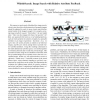
We propose a novel mode of feedback for image search, where a user describes which properties of exemplar images should be adjusted in order to more closely match his/her mental m...
268
click to vote
CVPR
2012
IEEE
13 years 9 months ago
2012
IEEE

Active learning aims to reduce the amount of labels required for classification. The main difficulty is to find a good trade-off between exploration and exploitation of the lab...
210
click to vote
CVPR
2012
IEEE
13 years 9 months ago
2012
IEEE
In many vision problems, rotation-invariant analysis is necessary or preferred. Popular solutions are mainly based on pose normalization or brute-force learning, neglecting the in...
233
click to vote
CVPR
2012
IEEE
13 years 9 months ago
2012
IEEE
In this work we seek to move away from the traditional paradigm for 2D object recognition whereby objects are identified in the image as 2D bounding boxes. We focus instead on: i...