247
click to vote
CVPR
2012
IEEE
13 years 9 months ago
2012
IEEE

Current object class recognition systems typically target 2D bounding box localization, encouraged by benchmark data sets, such as Pascal VOC. While this seems suitable for the de...
243
click to vote
CVPR
2012
IEEE
13 years 9 months ago
2012
IEEE
Modeling objects using formal grammars has recently regained much attention in computer vision. Probabilistic logic programming, such as Bilattice based Logical Reasoning (BLR), i...
237
click to vote
CVPR
2012
IEEE
13 years 9 months ago
2012
IEEE
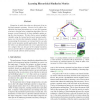
Categories in multi-class data are often part of an underlying semantic taxonomy. Recent work in object classification has found interesting ways to use this taxonomy structure t...
243
click to vote
CVPR
2012
IEEE
13 years 9 months ago
2012
IEEE
We propose an efficient algorithm to find the exact nearest neighbor based on the Euclidean distance for largescale computer vision problems. We embed data points nonlinearly on...
233
click to vote
CVPR
2012
IEEE
13 years 9 months ago
2012
IEEE
Bottom-up, fully unsupervised segmentation remains a daunting challenge for computer vision. In the cosegmentation context, on the other hand, the availability of multiple images ...
198
click to vote
CVPR
2012
IEEE
13 years 9 months ago
2012
IEEE
It has been widely believed that biometric template aging does not occur for iris biometrics. We compare the match score distribution for short time-lapse iris image pairs, with a...
249
click to vote
CVPR
2012
IEEE
13 years 9 months ago
2012
IEEE
We propose a framework that performs action recognition and identity maintenance of multiple targets simultaneously. Instead of first establishing tracks using an appearance mode...
261
click to vote
CVPR
2012
IEEE
13 years 9 months ago
2012
IEEE
A greedy-based approach to learn a compact and discriminative dictionary for sparse representation is presented. We propose an objective function consisting of two components: ent...
209
click to vote
CVPR
2012
IEEE
13 years 9 months ago
2012
IEEE
We propose an adaptive figure-ground classification algorithm to automatically extract a foreground region using a user-provided bounding-box. The image is first over-segmented wi...
235
Voted
CVPR
2012
IEEE
13 years 9 months ago
2012
IEEE
In this paper we present the first large-scale scene attribute database. First, we perform crowd-sourced human studies to find a taxonomy of 102 discriminative attributes. Next,...