219
click to vote
AAAI
2011
14 years 6 months ago
2011

Effective access to knowledge within large declarative memory stores is one challenge in the development and understanding of long-living, generally intelligent agents. We focus o...
185
click to vote
AAAI
2011
14 years 6 months ago
2011
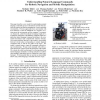
This paper describes a new model for understanding natural language commands given to autonomous systems that perform navigation and mobile manipulation in semi-structured environ...
174
click to vote
AAAI
2011
14 years 6 months ago
2011
Recognizing possibly thousands of objects is a crucial capability for an autonomous agent to understand and interact with everyday environments. Practical object recognition comes...
174
click to vote
AAAI
2011
14 years 6 months ago
2011
In this paper we propose differential eligibility vectors (DEV) for temporal-difference (TD) learning, a new class of eligibility vectors designed to bring out the contribution of...
187
click to vote
AAAI
2011
14 years 6 months ago
2011
Suppose an unpredictable evader is free to move around in a polygonal environment of arbitrary complexity that is under full camera surveillance. How many pursuers, each with the ...
183
click to vote
AAAI
2011
14 years 6 months ago
2011
Information about the spread of crop disease is vital in developing countries, and as a result the governments of such countries devote scarce resources to gathering such data. Un...
156
click to vote
AAAI
2011
14 years 6 months ago
2011
Many algorithms for performing inference in graphical models have complexity that is exponential in the treewidth - a parameter of the underlying graph structure. Computing the (m...
175
click to vote
AAAI
2011
14 years 6 months ago
2011

Automated feature discovery is a fundamental problem in machine learning. Although classical feature discovery methods do not guarantee optimal solutions in general, it has been r...
182
click to vote
AAAI
2011
14 years 6 months ago
2011
Freuder and Elfe (1996) introduced Neighborhood Inverse Consistency (NIC) for binary CSPs. In this paper, we introduce RNIC, the extension of NIC to nonbinary CSPs, and describe a...
157
click to vote
AAAI
2011
14 years 6 months ago
2011

The utility of including cyclic flow of control in plans has been long recognized by the planning community. Loops in a plan increase both its applicability and the compactness o...