115
click to vote
ACL
2015
10 years 3 months ago
2015

Our research focuses on the multilingual enhancement of ontologies that, often represented only in English, need to be translated in different languages to enable knowledge access...
115
click to vote
ACL
2015
10 years 3 months ago
2015
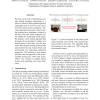
We focus on the task of interpreting complex natural language instructions to a robot, in which we must ground high-level commands such as microwave the cup to low-level actions s...
129
click to vote
ACL
2015
10 years 3 months ago
2015
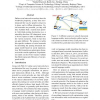
Online social networks nowadays have the worldwide prosperity, as they have revolutionized the way for people to discover, to share, and to diffuse information. Social networks ar...
115
click to vote
ACL
2015
10 years 3 months ago
2015
Most existing graph-based parsing models rely on millions of hand-crafted features, which limits their generalization ability and slows down the parsing speed. In this paper, we p...
123
click to vote
ACL
2015
10 years 3 months ago
2015
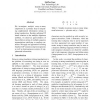
We investigate multiple many-to-many alignments as a primary step in integrating supplemental information strings in string transduction. Besides outlining DP based solutions to t...
136
click to vote
ACL
2015
10 years 3 months ago
2015
We present a novel solution to improve the performance of Chinese word segmentation (CWS) using a synthetic word parser. The parser analyses the internal structure of words, and a...
136
click to vote
ACL
2015
10 years 3 months ago
2015
A key problem in semantic parsing with graph-based semantic representations is graph parsing, i.e. computing all possible analyses of a given graph according to a grammar. This pr...
113
click to vote
ACL
2015
10 years 3 months ago
2015
This paper proposes an approach to capture the pragmatic context needed to infer irony in tweets. We aim to test the validity of two main hypotheses: (1) the presence of negations...
140
click to vote
ACL
2015
10 years 3 months ago
2015
Given a set of basic binary features, we propose a new L1 norm SVM based feature selection method that explicitly selects the features in their polynomial or tree kernel spaces. T...
126
click to vote
ACL
2015
10 years 3 months ago
2015
We explore using relevant tweets of a given news article to help sentence compression for generating compressive news highlights. We extend an unsupervised dependency-tree based s...