127
Voted
ACL
2015
10 years 3 months ago
2015

Text regression has traditionally been tackled using linear models. Here we present a non-linear method based on a deep convolutional neural network. We show that despite having m...
118
Voted
ACL
2015
10 years 3 months ago
2015
Syntactic annotation is a hard task, but it can be made easier by allowing annotators flexibility to leave aspects of a sentence underspecified. Unfortunately, partial annotatio...
128
Voted
ACL
2015
10 years 3 months ago
2015
Recent work on language modelling has shifted focus from count-based models to neural models. In these works, the words in each sentence are always considered in a left-to-right o...
131
Voted
ACL
2015
10 years 3 months ago
2015
Given a discourse tree for a text as a candidate answer to a compound query, we propose a rule system for valid and invalid occurrence of the query keywords in this tree. To be a ...
128
Voted
ACL
2015
10 years 3 months ago
2015
Using natural language to write programs is a touchstone problem for computational linguistics. We present an approach that learns to map natural-language descriptions of simple â...
134
Voted
ACL
2015
10 years 3 months ago
2015
Multi-modal semantics has relied on feature norms or raw image data for perceptual input. In this paper we examine grounding semantic representations in olfactory (smell) data, th...
112
Voted
ACL
2015
10 years 3 months ago
2015
This paper presents the NL2KR platform to build systems that can translate text to different formal languages. It is freelyavailable1, customizable, and comes with an Interactive ...
118
Voted
ACL
2015
10 years 3 months ago
2015
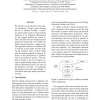
We present a novel approach to the selective annotation of large corpora through the use of machine learning. Linguistic search engines used to locate potential instances of an in...
122
click to vote
ACL
2015
10 years 3 months ago
2015
In this paper, we present a model for improved discriminative semantic parsing. The model addresses an important limitation associated with our previous stateof-the-art discrimina...
116
Voted
ACL
2015
10 years 3 months ago
2015
People create morphs, a special type of fake alternative names, to achieve certain communication goals such as expressing strong sentiment or evading censors. For example, “Blac...